
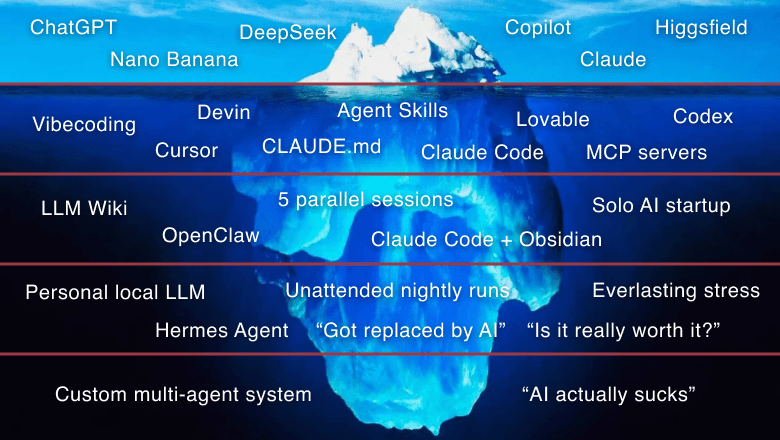
The iceberg of AI usage
July 3, 2026 — July 8, 2026 · 6 parts · 27 min read
- ai
- claude-code
- multi-agent
- llm-wiki
A six-part series on how I use AI in day-to-day engineering work: the Claude Code toolbox, typical setup mistakes, the theory behind multi-agent systems, an agentic HR department built for a real job search, orchestrating agents through a team lead, and agent memory with the Lessons mechanism.
In this series
Claude Code fundamentals
Part 1 · July 3, 2026 · 3 min read
Pressured by AI KPIs at work, I map out the modern Claude Code toolbox from the ground up: MCP servers, skills, agents, hooks, and plugins — what each one is, when to use it, and where the docs are.
Common Claude Code setup mistakes
Part 2 · July 4, 2026 · 5 min read
Typical Claude Code setup mistakes and how to avoid them: vibe-setups configured by AI itself, a bloated CLAUDE.md, conflicting instructions, wrong model choice, vague skill descriptions, abstract agent roles, and agents that can do everything.
Theory of building multi-agent systems
Part 3 · July 5, 2026 · 6 min read
What multi-agent systems are and why context forces decomposition: when to delegate to subagents, how to split a task, Anthropic's coordination patterns, contracts, memory and verification — plus the token and debugging tradeoffs.
Building an agentic HR department
Part 4 · July 6, 2026 · 4 min read
Designing a job-search multi-agent system in practice: projecting the human hiring process into five agent roles — scout, curator, verifier, hr-specialist, reviewer — with the complete agent definitions for each one.
Orchestrating agents
Part 5 · July 7, 2026 · 3 min read
How a team-lead orchestrator turns folders of agents into a working pipeline: the full CLAUDE.md, PIPELINE.md and config.yaml, how agents hand work to each other through shared memory on disk, and why hooks must guard a non-deterministic LLM.
Agent memory & lessons
Part 6 · July 8, 2026 · 8 min read
Long-term memory for agents via an LLM wiki vault, the Lessons mechanism that turns mistakes and user corrections into reusable rules, the honest problems of my approach, and a closing word.