
The iceberg of AI usage · Part 1 of 6
Claude Code fundamentals
July 3, 2026 · 3 min read
- ai
- claude-code
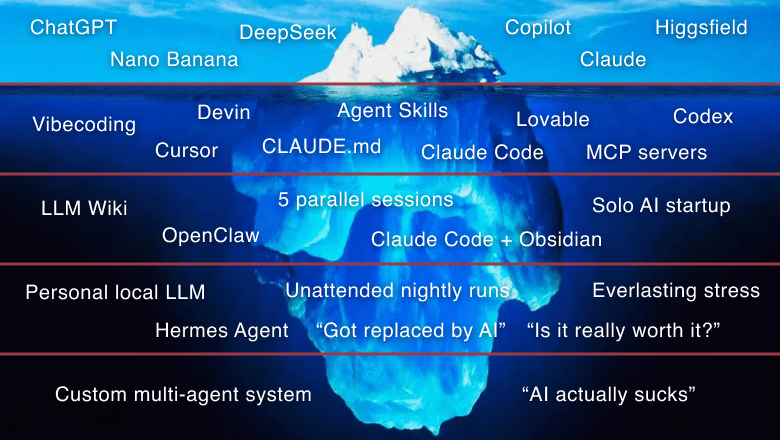
Who is this article for and what will it cover?
I want to lower the entry barrier as much as possible, diving into the topic step by step, so that everyone can find something useful for themselves and stop at whatever level suits them.
This article is a good fit for those who want to go deeper into using AI models and already have some understanding and hands-on experience.
Your specific specialization doesn't matter, because there are no real fundamental differences in how it's used.
Disclaimer
In this article I'll be leaning on Claude Code, so don't be surprised to see definitions and links to their documentation. I assume you already know how to prompt and have a basic understanding of how the technology works.
Diving into the topic
In this section we'll briefly go over the basic terms and concepts from the documentation, without which it's impossible to move forward. If this is too easy for you — feel free to skip this block.
MCP
MCP (Model Context Protocol) is an open protocol that lets any LLM connect to external tools and data. With it, an LLM can interact with your Google Calendar, or your knowledge base in Obsidian or Notion.
You can look for MCP servers on various marketplaces, similar to skills (for example, mcpmarket.com, claudemarketplaces.com).
- I recommend reading the documentation page in full.
- MCP quickstart for Claude Code.
- An article about MCP on Habr for those who don't like reading documentation.
Skills
A skill is an open format that extends agents' capabilities with specialized knowledge and pre-built work scenarios.
You can find skills on services like skills.sh, or create your own to fit your needs.
- I recommend reading the documentation page in full.
- The open agent skills standard.
- An article about skills on Habr for those who don't like reading documentation.
Agents
The most important concept for us. In Claude Code, an "Agent" is a separate specialized instance that a subtask gets delegated to (they're also called subagents).
Let's say I want a pre-built reviewer preset that audits my code before a commit. To get a quality result, I'll take the following steps:
- Give the agent a role in the system prompt, for example, "you are a nitpicky reviewer, you look for mistakes and suggest improvements."
- Give it the ability to only read files, with no ability to change anything. A reviewer shouldn't fix code itself.
- Install the right skills (code-review, security-review, typescript-clean-code,...) for a quality check of the result.
- Install the "Atlassian (Jira) MCP" to pull in the relevant ticket the task was done for.
The preset is ready. Now, instead of explaining to Claude every time that I want a review, I just call this agent.
Hooks
Hooks are automatic commands that run at specific points in Claude Code's operation. They guarantee that the necessary actions always happen, regardless of the model's non-deterministic decisions.
Plugins
A plugin is a ready-made package of components that bundles skills, agents, hooks, and MCP servers to solve a specific task. A plugin lets you install the entire setup you need with a single command instead of manually configuring each component separately.